A TenantCloud alternative for landlords who manage for others
TenantCloud is a long-standing landlord tool known for tiered plans that suit small portfolios, with listings, screening and rent collection on offer. If you are outgrowing it or managing for owners, here is how The Property Tool compares.
How they compare
TenantCloud is built for the landlord who owns what they manage: list the vacancy, screen the applicant, collect the rent, keep the books. That is a coherent product and, for many people, the right size. The friction tends to show up in two situations: when part of the portfolio rents by the night, and when somebody other than you owns the property.
| Area | The Property Tool | TenantCloud |
|---|---|---|
| Built around | Managers and landlords reporting to owners, long-term and short-term mixed | Self-managing landlords working through listings, screening and rent collection |
| Owner reporting | Owner statements, fee rules, splits and an owner portal | Landlord-side bookkeeping; owner reporting is not the centre |
| Short-term stays | Booking calendar, channel sync and turnover tasks | Oriented to leases and monthly rent |
| Rent collection | Online payments with per-tenant ledgers | Online payments are a core feature of the plans |
| Pricing shape | A base that covers five units, then a price per unit | Tiered plans by number of units |
| Association work | HOA and syndic modules priced per lot | Not the focus |
Where the two products diverge
Both help you stop managing rent with a spreadsheet and a payments app. The paths separate on what the unit of work is. For a landlord tool it is the tenancy: a vacancy, an applicant, a lease, a monthly charge. For a manager it is the owner relationship, because the same tenancy now has to be reported to someone else on a fixed rhythm.
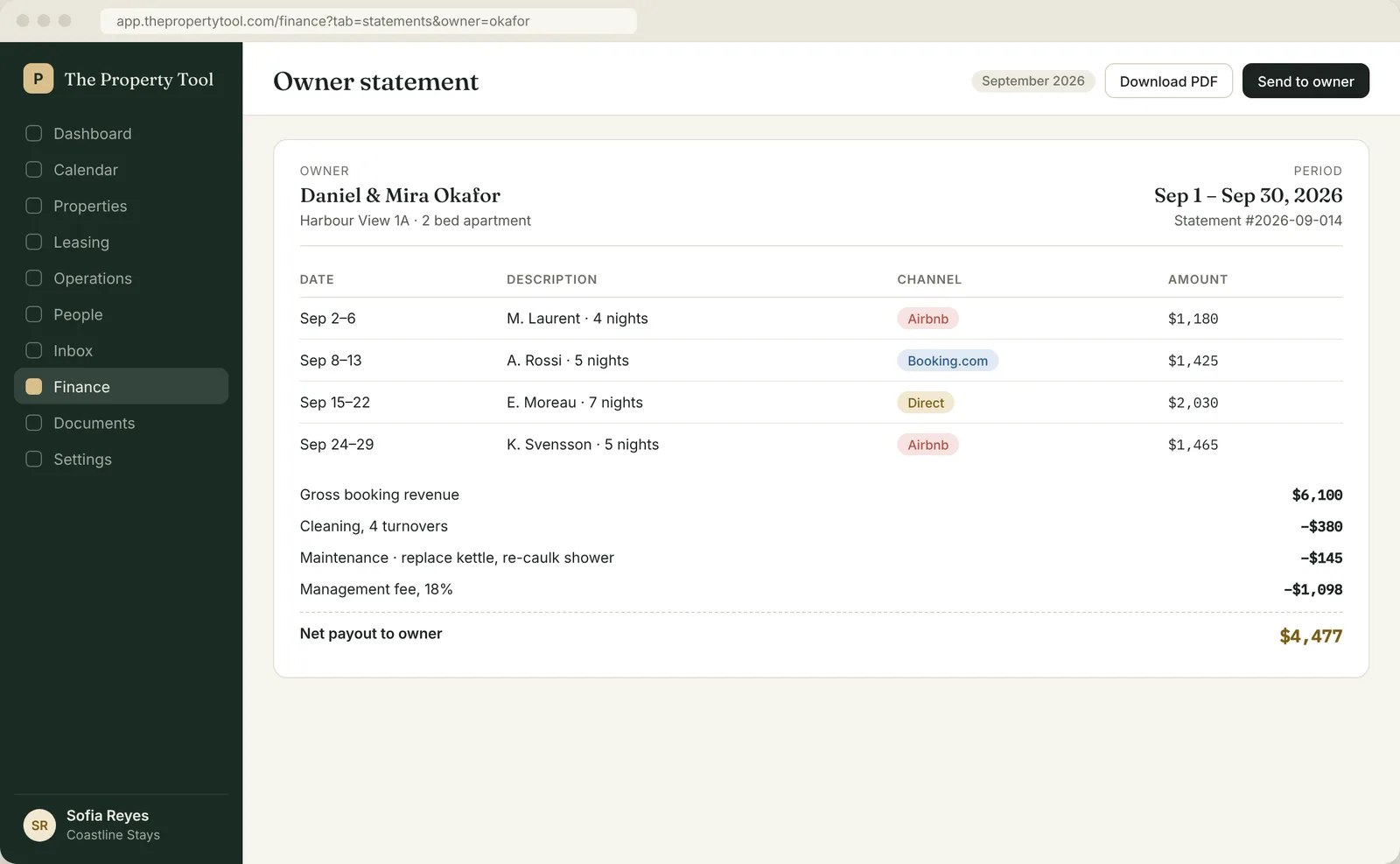
If you recognise the second description, the useful test is simple: can the system produce what you would send an owner at the end of the month, without you rebuilding it from exports?
Mixed portfolios
A common drift is one furnished flat let by the week, then two, alongside the long-term leases. A tenancy-first tool handles the leases and strains on the nightly stays; a booking-first tool does the reverse. Here both live in one account: leases and rent charges next to the booking calendar, with one ledger per property.
That removes the second system, and with it the duplicated expenses and the question of which spreadsheet is right.
What you would give up
A tiered, landlord-focused plan can be cheaper at the smallest scale, and some of its marketplace and listing features have no direct equivalent here. If you rely on syndicating vacancies to a wide set of listing sites, compare that workflow carefully before moving.
Pricing here follows your unit count rather than a plan name, so a portfolio of three units costs less than one of thirty, with no feature held back at either size.
Moving the records
Export tenants, leases and the rent ledger first, and bring in current leases rather than history older than your records need. Check opening balances against the bank before the first month closes, since a wrong starting balance is the most common reason a migrated ledger looks off.
Keep payments on the old system until tenants have been invited to the new portal, so rent keeps landing in one place while the switch happens.
A quick way to decide
Count what you do each month that is not rent. If it is mostly vacancies, applicants and the occasional repair, a landlord tool is enough and probably cheaper. If it includes owner statements, nightly bookings, turnover scheduling or an association, you are using a manager’s workflow, and a manager’s tool saves the manual steps. Write the two lists down for one real month before comparing prices, because the honest answer usually appears at that point.
When The Property Tool is the better fit
If your portfolio includes nightly stays, or you report to owners who expect a statement every month, The Property Tool keeps leases, bookings and owner reporting in one account.
When TenantCloud is the better fit
If you own every unit you manage, let them long-term, and want a landlord tool with plans sized to small portfolios, TenantCloud is worth evaluating directly.
Other TenantCloud alternatives
- BuildiumBest for: large residential portfolios with complex lease and trust accounting, plus associations
- AppFolioBest for: several hundred residential units run by a team with a dedicated finance function
- TurboTenantBest for: individual landlords with one or two units who want free listing, screening and rent collection
- DoorLoopBest for: all-in-one long-term residential or commercial leasing with deep accounting
- Rentec DirectBest for: long-term residential leasing with trust accounting and tenant screening built in
- Yardi BreezeBest for: audited property accounting with a path into the wider yardi ecosystem
- RentvineBest for: established residential management companies moving off an older platform
- PropertywareBest for: large single-family rental portfolios that want a deeply configurable platform
- AvailBest for: diy us landlords filling long-term vacancies with free listing, transunion screening and rent collection
- RentRediBest for: hands-on landlords who want a tenant app and a flat annual bill that does not rise with unit count
- InnagoBest for: independent us landlords who want a full landlord os at $0, funded by tenant payment and screening fees
- HemlaneBest for: owners who want software plus optional repair coordination or a done-for-you management assistant
- BaselaneBest for: investors who want property-level bank accounts, bookkeeping and rent collection more than a pm system
- Landlord StudioBest for: diy landlords who want receipt capture and tax-ready reports above everything else
- Rent ManagerBest for: large or unusual portfolios, including commercial, that need deep customisation
- StessaBest for: investors who want income, expense and return tracking from linked bank accounts
- Zillow Rental ManagerBest for: landlords who mainly need to advertise vacancies, take applications and screen at no subscription cost
- EntrataBest for: operators of larger apartment communities with leasing staff and enterprise reporting needs
- CINC SystemsBest for: management companies that run many community associations and rely on violation and board workflows
Comparing TenantCloud with another tool?
Common questions
Can I collect rent online?
Yes. Rent collection is built in, with a ledger per tenant and a portal for them to pay through.
Does it handle e-signed leases?
Yes. E-signatures are included, and signed documents stay attached to the lease.
Is it overkill for two or three units?
It works at that size, since the price follows the number of units, but if you own everything and never report to anyone, a simpler landlord tool may be enough.
Can I try it before moving?
There is a 14-day trial without a card. Import one property and run a month through it before you switch the rest.
See it running on your portfolio.
Create an account and add your first property — no setup calls required.
Create your accountRelated pages
Vacation rental software vs. property management software: what is the difference?
The terms get used interchangeably, but they solve different problems. Here is how to tell which category actually fits what you are managing.
MaintenanceThe property manager's guide to work order and vendor management
A work order is only as good as the vendor assigned to it. Here is how to find reliable vendors, build a vendor management process, and stop depending on remembering who to call.
Landlord-Tenant LawCalifornia fee transparency law (SB 478) and the other rental fee rules landlords must follow
California's Honest Pricing Law bans advertising a rent price that leaves out mandatory fees. Here is what it actually requires in a rental listing and application flow.