A Landlord Studio alternative for when bookkeeping is not the whole job
Landlord Studio is liked by self-managing landlords for its accounting: scan a receipt, categorise it, produce the tax report. If your work has grown into tenants, bookings and owners as well, here is how The Property Tool compares.
How they compare
Landlord Studio starts from the books, which is a sound place to start: a landlord who knows income, expenses and receipts per property is ahead of most. The question is what you need next to the books. For a self-managing landlord with a handful of long-term lets the answer may be nothing. For a manager it is usually a calendar, tasks and reporting to owners.
| Area | The Property Tool | Landlord Studio |
|---|---|---|
| Starting point | Operations first: calendar, tasks, tenants and owners, with accounting derived from them | Accounting first: receipts, categories and tax-ready reports |
| Expense capture | Expenses logged against a property and carried into statements | Strong mobile receipt capture and bank feed categorisation |
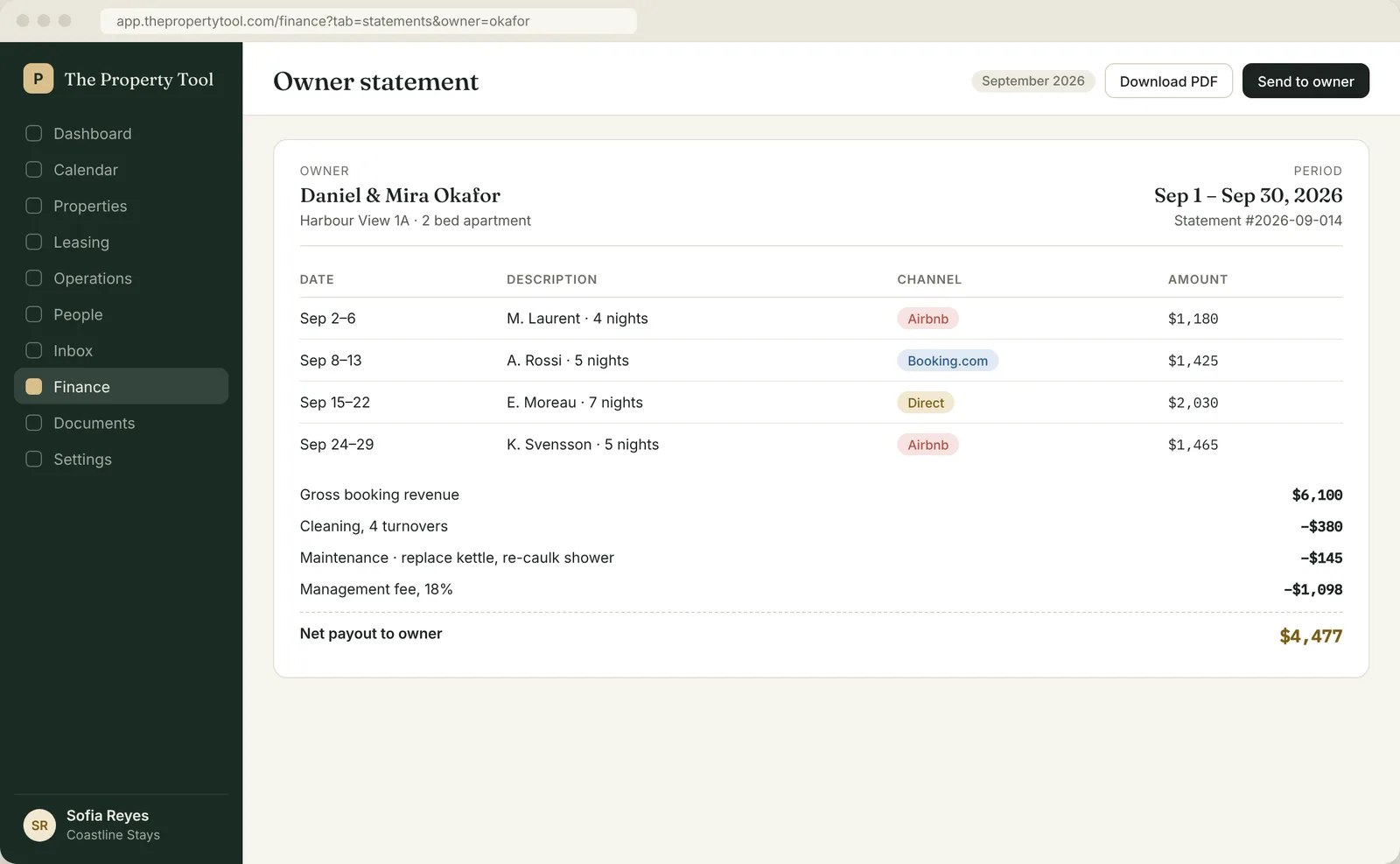
| Owner reporting | Statements, fee rules, splits and an owner portal | Reports for the landlord who owns the property |
| Bookings | Calendar with channel sync and a booking site | Not a booking tool |
| Maintenance | Tasks and work orders with vendors | Maintenance requests and tracking |
| Tax reporting | Exports for your accountant; not a tax filing product | Reports designed around landlord tax returns |
Books-first versus operations-first
An accounting-first tool asks you to record what happened. An operations-first tool records it as a side effect of doing the work: a stay is booked, so income posts; a cleaning task closes, so the cost lands on the property. Neither approach is wrong, but they suit different people.
If you do the work in other tools and need the books to be tidy, the first is lighter. If the work itself happens in the system, the second saves you entering things twice.
What changes when you manage for owners
A landlord owes a tax return; a manager owes each owner a statement and, often, a payout. That difference is why owner statements, a fee calculated by stated rule and co-owner splits matter more than categories do.
The books still matter. Reports and exports give your accountant the figures per property and per owner, but the aim is that they come out of the work rather than being compiled after it.
What you would give up
Landlord Studio is well regarded for polished mobile capture and for tax-oriented reports that follow the filing rules of several countries. This product is not a tax filing tool, and it will not replace an accountant who prepares returns.
If your main pain is shoeboxes of receipts and an upcoming tax deadline, an accounting-first tool answers it more directly, and you can keep one even while using this for operations.
Moving across
Export transactions per property with categories intact, and decide a cut-off date such as the start of a tax year so reports do not straddle two systems. Bring opening balances in rather than history you will never open again.
Run both for one month in parallel and compare the property totals before you close the old account; any difference is a missing transaction, and it is easier to find in month one than month eight.
A quick way to decide
Look at the last thirty days and list what took longest. If it was categorising spending and finding receipts, you want an accounting tool and should keep one. If it was chasing a cleaner, answering a guest, matching a payment to a booking or building a report for an owner, the time went into operations, and that is where a system that records the work as it happens pays back. Many portfolios use one of each, and that is a reasonable outcome.
When The Property Tool is the better fit
If bookings, tenants, maintenance and owner reports are already the larger part of your week, and you would rather the books follow from that work than be typed in after it, The Property Tool is built that way.
When Landlord Studio is the better fit
If you own long-term rentals, manage them yourself and want strong mobile receipt capture and tax-ready reports above everything else, Landlord Studio is worth evaluating directly.
Other Landlord Studio alternatives
- BuildiumBest for: large residential portfolios with complex lease and trust accounting, plus associations
- AppFolioBest for: several hundred residential units run by a team with a dedicated finance function
- TurboTenantBest for: individual landlords with one or two units who want free listing, screening and rent collection
- DoorLoopBest for: all-in-one long-term residential or commercial leasing with deep accounting
- Rentec DirectBest for: long-term residential leasing with trust accounting and tenant screening built in
- Yardi BreezeBest for: audited property accounting with a path into the wider yardi ecosystem
- RentvineBest for: established residential management companies moving off an older platform
- PropertywareBest for: large single-family rental portfolios that want a deeply configurable platform
- AvailBest for: diy us landlords filling long-term vacancies with free listing, transunion screening and rent collection
- RentRediBest for: hands-on landlords who want a tenant app and a flat annual bill that does not rise with unit count
- InnagoBest for: independent us landlords who want a full landlord os at $0, funded by tenant payment and screening fees
- HemlaneBest for: owners who want software plus optional repair coordination or a done-for-you management assistant
- BaselaneBest for: investors who want property-level bank accounts, bookkeeping and rent collection more than a pm system
- TenantCloudBest for: self-managing landlords who want listings, screening and rent collection in a tiered plan
- Rent ManagerBest for: large or unusual portfolios, including commercial, that need deep customisation
- StessaBest for: investors who want income, expense and return tracking from linked bank accounts
- Zillow Rental ManagerBest for: landlords who mainly need to advertise vacancies, take applications and screen at no subscription cost
- EntrataBest for: operators of larger apartment communities with leasing staff and enterprise reporting needs
- CINC SystemsBest for: management companies that run many community associations and rely on violation and board workflows
Common questions
Does it categorise expenses?
Expenses are logged against the property and carried into statements and reports. It is not built around bank-feed categorisation the way a bookkeeping tool is.
Can my accountant get the numbers?
Yes, through data export by property, owner and period.
Will it prepare my tax return?
No. It supplies the figures; filing remains with you or your accountant.
Can I use both together?
Many people do: operations here and an accounting tool for tax. Export the period totals at month end and reconcile them.
See it running on your portfolio.
Create an account and add your first property — no setup calls required.
Create your accountRelated pages
California security deposit law: the cap, the 21-day deadline and the photo rules
California caps most deposits at one month’s rent, requires the balance and an itemised statement within 21 days, and since 2025 requires photos for cleaning and repair deductions.
Property Management SoftwareWhat is property management software? A plain-English guide
Property management software replaces spreadsheets, group texts, and paper folders with one system for bookings, owners, tasks, and money. Here is what it actually does.
Short-Term Rental RegulationsUS short-term rental laws by city: New York, San Francisco, Los Angeles and Washington DC
Four large US cities limit short-term rental to hosts who live there. What each one requires on residency, registration and nights per year.