A DoorLoop alternative for portfolios that mix short-term and long-term rentals
DoorLoop is a strong all-in-one platform built primarily around long-term residential and commercial leasing, accounting, and maintenance. If your portfolio includes short-term or vacation rentals and you want the booking calendar built in rather than bolted on, here is how The Property Tool compares.
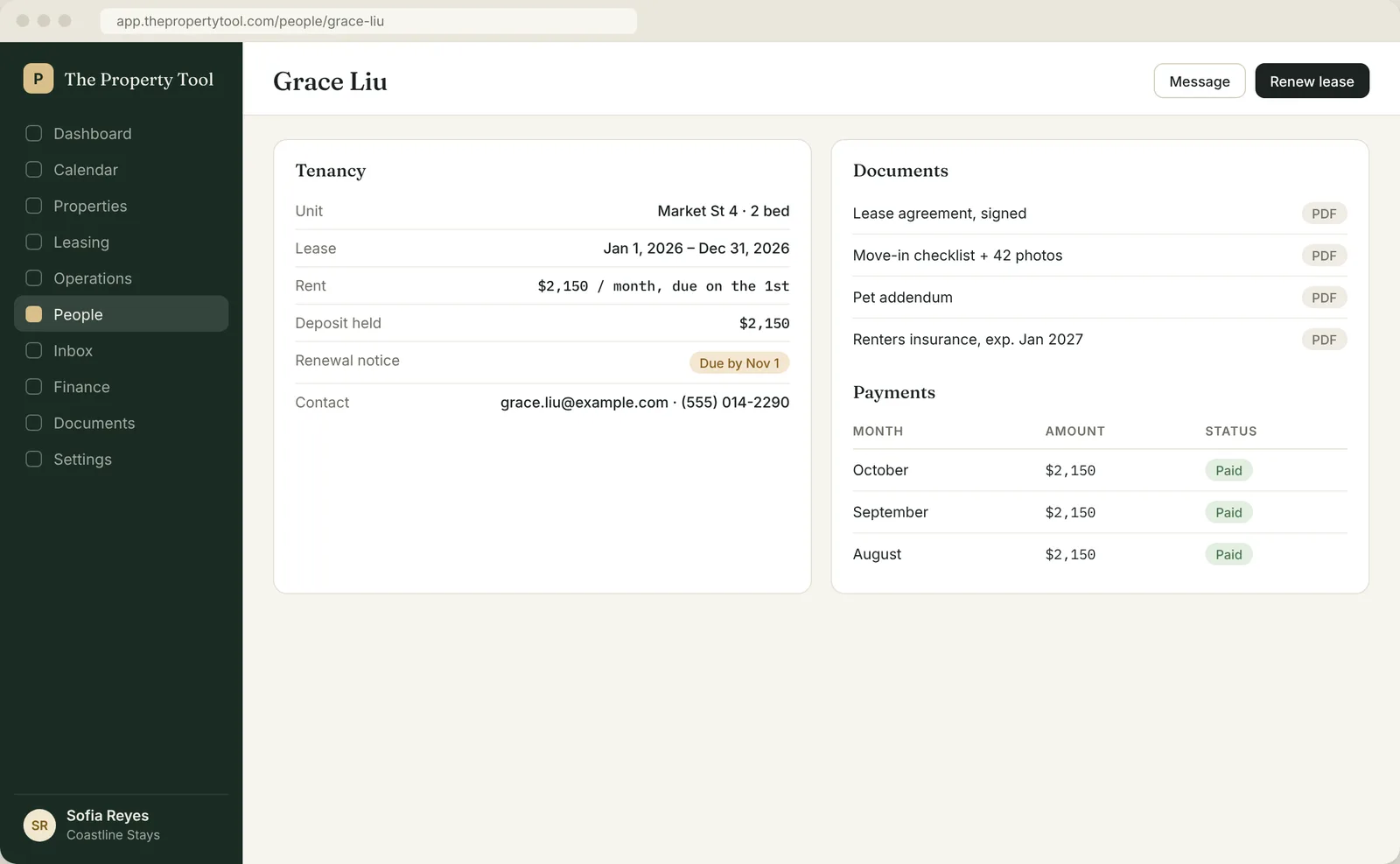
How they compare
DoorLoop is a capable all-in-one for leasing-led portfolios and is regularly praised for its support and its accounting. The relevant question is what fraction of your portfolio turns over faster than a monthly lease, because a leasing-led system and a stay-led system make different assumptions at the level of the data model, not just the interface.
| Area | The Property Tool | DoorLoop |
|---|---|---|
| Occupancy model | The nightly stay is the primitive; a lease is a long stay | The lease is the primitive; short stays sit outside the model |
| Accounting depth | Per-property ledgers, fees and splits; exports to your accountant | Full accounting suite, a frequently cited strength |
| Commercial property | Not a target case | Supported alongside residential |
| Turnover operations | Checkout can generate cleaning and inspection tasks automatically | Maintenance and work orders built for a leasing cadence |
| Owner splits | A 60/40 property divides income, costs and fees by share automatically | Owner reporting present; co-ownership splits less central |
| Onboarding | Self-serve, no implementation step | Guided onboarding is part of the standard motion |
Why the occupancy model decides this
Software built around a lease assumes occupancy is long, rent is fixed per period, and the gap between tenancies is an exception to be minimised. Software built around a stay assumes occupancy is short, the rate varies by night, and the gap between stays is where the operational work happens.
You can bend either model toward the other, but bending costs you daily. If a meaningful share of your units turn over weekly, a leasing-first calendar will need a spreadsheet beside it — which is the specific problem The Property Tool's calendar exists to remove.
Where DoorLoop is stronger
Accounting depth and breadth of property type. If your portfolio is entirely long-term residential or includes commercial leases, and you want a general ledger, reconciliation and lease-level accounting in one place, that is squarely DoorLoop territory and a good reason to stay.
The Property Tool keeps per-property financial records and exports cleanly to whatever your accountant uses, but it does not set out to be a full accounting suite. Being clear about that is more useful than claiming parity.
What a mixed portfolio looks like here
One calendar holds a twelve-month tenancy in unit 1 and a four-night booking in unit 2. Both post income to their own property ledger. A checkout in unit 2 raises a cleaning task with an assignee and a due date; the vendor cost attaches to the task and lands in that property's statement. The owner of unit 2 sees their share, net of the management fee, in their own portal.
That is the whole argument: nothing in that sequence requires a second system or a reconciliation step. If your portfolio is heading toward mid-term rentals as well, the same model covers those without a third arrangement.
Migration and pricing
Take out property, unit, tenant and lease records, owner records and splits, open maintenance items, and enough transaction history for continuity. Cut over at a period boundary and run the final statements from the old system. Switching property management software has the full checklist.
Pricing here is a published monthly price with no onboarding fee and no per-transaction cut, and the modules are included. It is all on the pricing page.
If you also manage shared buildings
Portfolios rarely stay one shape. Alongside vacation rentals and long lets, The Property Tool carries a third mode for syndic and co-ownership work — shared buildings with multiple co-owners, governance, and reserve funds — which you switch on per organisation rather than running in a separate system.
That matters here because leasing-led platforms generally treat association or co-ownership management as a distinct product line. If your portfolio spans a building you administer for its co-owners and a handful of units you let short-term, being able to hold both is worth more than depth in either one alone.
A practical way to decide: count your turnovers
Take last year and count how many times a unit changed occupant. If the answer is one or two per unit, a leasing-first platform fits and DoorLoop is a serious contender. If the answer is dozens per unit, the calendar, the rate rules and the cleaning schedule matter more than lease tooling, and that is where a stay-first model earns its place.
Most mixed portfolios land in between: a few long tenancies that rarely change and a few units that never stop turning over. For those, the deciding factor is whether you are willing to keep two systems and reconcile them monthly. Switching property management software and the long-term vs short-term comparison cover that trade-off in more detail.
What to ask in a trial of either product
Enter one real tenancy and one real four-night booking in the same trial account. Post a rent payment and a cleaning cost, then generate the owner statement. Check that each number lands on the right property, that the management fee is calculated the way your contract says, and that the owner can see it without you sending a PDF.
Then ask the harder questions: what happens to a booking when the guest extends, how a security deposit is handled differently from a nightly rate, and what the export looks like when your accountant asks for the year. A product that answers all of those without a workaround is the one to keep.
Maintenance and work orders: leasing cadence versus turnover cadence
A long-term maintenance workflow starts with a tenant request, moves through approval and a vendor visit, and ends with an invoice. It is reactive and spread over weeks. A short-term workflow is mostly proactive: every checkout creates a known set of jobs with a hard deadline, because the next guest arrives the same day.
DoorLoop handles the first pattern well. The Property Tool handles both in one place: a tenant can raise a maintenance request like in any leasing system, while a checkout automatically creates the cleaning and inspection tasks. Both kinds of cost attach to the property and reach the owner statement. See work order and vendor management for what to look for in either case.
Rent, deposits and nightly payments in one record
A leasing platform is built around a recurring rent charge: same amount, same date, same tenant. A stay-based record has a different rhythm: a deposit or prepayment at booking, a balance before arrival, and sometimes a refund after checkout. Forcing nightly bookings into recurring-rent logic usually means manual adjustments each month.
Here both live side by side. A twelve-month tenancy keeps its monthly schedule and its security deposit, handled the way security deposit management describes, while a short booking carries its own payment and deposit terms. Rent arrives by bank transfer and is matched from your bank export; how to collect rent compares the other options.
Owner reporting for mixed portfolios
If you manage properties for other owners, the report they receive matters as much as the software you run behind it. A long-term owner expects rent collected, costs paid and a clear net. A short-term owner expects the same plus occupancy and the fee you charged on each booking.
Both are produced from the same ledger as owner statements, with management fees calculated to a rule you set. Property management fee structures explains the common models, and what an owner statement is shows what a statement should contain so owners stop asking for corrections.
Questions to ask before choosing either platform
Ask how the product models a booking that is not a lease. Ask where the management fee is calculated and whether you can show an owner exactly how a figure was reached. Ask what the export looks like at year end and whether you must pay extra for owner access or for each additional user.
Then ask the question about the future: if your portfolio gains a short-term unit, a mid-term furnished let, or a building you administer for co-owners, will the system accommodate it or will you start looking again? Comparing against the broader list of software options helps you check that you are not choosing on one feature alone.
When The Property Tool is the better fit
If any part of your portfolio is short-term or vacation rental, The Property Tool's calendar is built around nightly bookings and fast turnovers from the ground up — not adapted from a long-term leasing model — so it fits that pace without workarounds.
When DoorLoop is the better fit
If your portfolio is entirely long-term residential or commercial leasing and you want deep accounting, lease management, and maintenance in one all-in-one platform, DoorLoop's depth in that area is well established and worth evaluating directly.
Other DoorLoop alternatives
- BuildiumBest for: large residential portfolios with complex lease and trust accounting, plus associations
- AppFolioBest for: several hundred residential units run by a team with a dedicated finance function
- TurboTenantBest for: individual landlords with one or two units who want free listing, screening and rent collection
- Rentec DirectBest for: long-term residential leasing with trust accounting and tenant screening built in
- Yardi BreezeBest for: audited property accounting with a path into the wider yardi ecosystem
- RentvineBest for: established residential management companies moving off an older platform
- PropertywareBest for: large single-family rental portfolios that want a deeply configurable platform
- AvailBest for: diy us landlords filling long-term vacancies with free listing, transunion screening and rent collection
- RentRediBest for: hands-on landlords who want a tenant app and a flat annual bill that does not rise with unit count
- InnagoBest for: independent us landlords who want a full landlord os at $0, funded by tenant payment and screening fees
- HemlaneBest for: owners who want software plus optional repair coordination or a done-for-you management assistant
- BaselaneBest for: investors who want property-level bank accounts, bookkeeping and rent collection more than a pm system
- TenantCloudBest for: self-managing landlords who want listings, screening and rent collection in a tiered plan
- Landlord StudioBest for: diy landlords who want receipt capture and tax-ready reports above everything else
- Rent ManagerBest for: large or unusual portfolios, including commercial, that need deep customisation
- StessaBest for: investors who want income, expense and return tracking from linked bank accounts
- Zillow Rental ManagerBest for: landlords who mainly need to advertise vacancies, take applications and screen at no subscription cost
- EntrataBest for: operators of larger apartment communities with leasing staff and enterprise reporting needs
- CINC SystemsBest for: management companies that run many community associations and rely on violation and board workflows
Comparing DoorLoop with another tool?
Common questions
Does The Property Tool support commercial leases?
No — commercial real estate is outside its scope. It is built for residential letting, short stays, and portfolios holding both.
Is the accounting as deep as DoorLoop's?
No. There is no general ledger or bank reconciliation. There are per-property ledgers, calculated management fees, owner splits, and exports your accountant can work from.
Can I run both long leases and nightly bookings in one account?
Yes, and that is the case the product is designed around rather than a workaround.
Do maintenance costs flow into owner statements automatically?
Yes. A cost recorded against a maintenance task lands in that property's ledger and appears on the statement without a second entry.
Is there an onboarding call?
There does not need to be. Setup is self-serve and most teams are running the same day.
Is The Property Tool cheaper than DoorLoop?
It depends on your unit count and which modules you need. Here you pay a published monthly price after a 14-day free trial, with no onboarding fee and no per-transaction cut. Compare the figure for your portfolio on the pricing page against DoorLoop's current quote.
Can I import my data from DoorLoop?
Export properties, units, tenants, leases, owners and open maintenance items, then load them in. Cut over at a period boundary and finish the last statements in the old system so nothing is split across two sets of books.
Can owners see their own numbers?
Yes. Each owner gets a login scoped to their own properties and their own share, with a live statement they can open whenever they like.
Is DoorLoop better for a long-term-only portfolio?
Often yes, particularly if you need deep accounting or commercial leases. If your portfolio is entirely leasing-led, the case for switching is weaker and the honest advice is to compare both with your own numbers.
Can tenants pay rent online?
Not through a checkout in the app. Tenants pay by bank transfer, you match payments from your bank export, and each paid charge is counted in that property's owner statement.
How does the product handle security deposits?
A deposit is recorded against the tenancy or booking it belongs to and tracked separately from income, so it does not distort the owner statement. See security deposit management.
What if I only have one or two short-term units next to many leases?
That is a reasonable mixed portfolio. The 14-day free trial has no unit limit and needs no card, so you can test the short-term side without committing, while leaving the rest where it is.
Will my accountant be able to work with the exports?
Yes. Exports come in standard formats, per property, so your accountant can work from a file instead of reading screens.
See it running on your portfolio.
Create an account and add your first property — no setup calls required.
Create your accountRelated pages
California rent receipt laws: when you must provide one
California law requires a written rent receipt for cash payments, and on request for every other payment type. Here is what a compliant receipt has to include.
Buying GuideBest property management software for Airbnb hosts (2026)
Most Airbnb hosts need a calendar that cannot double-book, a way to keep guests informed and turnovers on time. Here is how to choose software by how many listings you run.
Property Management SoftwareWhat to look for in online rental property management software
Rental property management software has moved almost entirely online — here is what that actually buys you over a desktop tool or a spreadsheet, and what to check before you commit.