A Rent Manager alternative that is ready without a configuration project
Rent Manager is an established, highly customisable platform used by residential, commercial and association managers with large or unusual portfolios. If you want something you can run on day one, here is how The Property Tool compares.
How they compare
Rent Manager has a reputation for depth: custom fields, custom reports, many user roles, and a long list of integrations. Those are real strengths for a company with complex requirements and someone whose job is to configure the system. They are a cost for a team of three that wants the software to be done being set up by Friday.
| Area | The Property Tool | Rent Manager |
|---|---|---|
| Design philosophy | Sensible defaults that work immediately; fewer knobs | Deep customisation of fields, workflows and reports |
| Setup effort | A working account the same day | Typically a configuration and onboarding project |
| Portfolio scale | A few units to a few hundred | Small to very large, including commercial and associations |
| Short-term rentals | Booking calendar, channel sync and turnovers built in | Centred on long-term leasing |
| Custom reporting | Standard reports and exports; no report designer | Extensive custom reporting |
| Pricing shape | A published price per unit with every module included | Typically quoted to the size and modules of the portfolio |
Customisable or ready to use
Every system sits somewhere between two poles. At one end you receive a powerful toolkit and shape it to your process. At the other you receive a process that is already shaped, and you fit your habits to it. The right end depends on whether your process is unusual.
If you manage a mix of commercial leases, association accounts and bespoke billing rules, customisation is the point. If you run residential units and short-term stays much like everyone else does, much of that flexibility is something you would pay for in setup time and never use.
What the day-to-day looks like
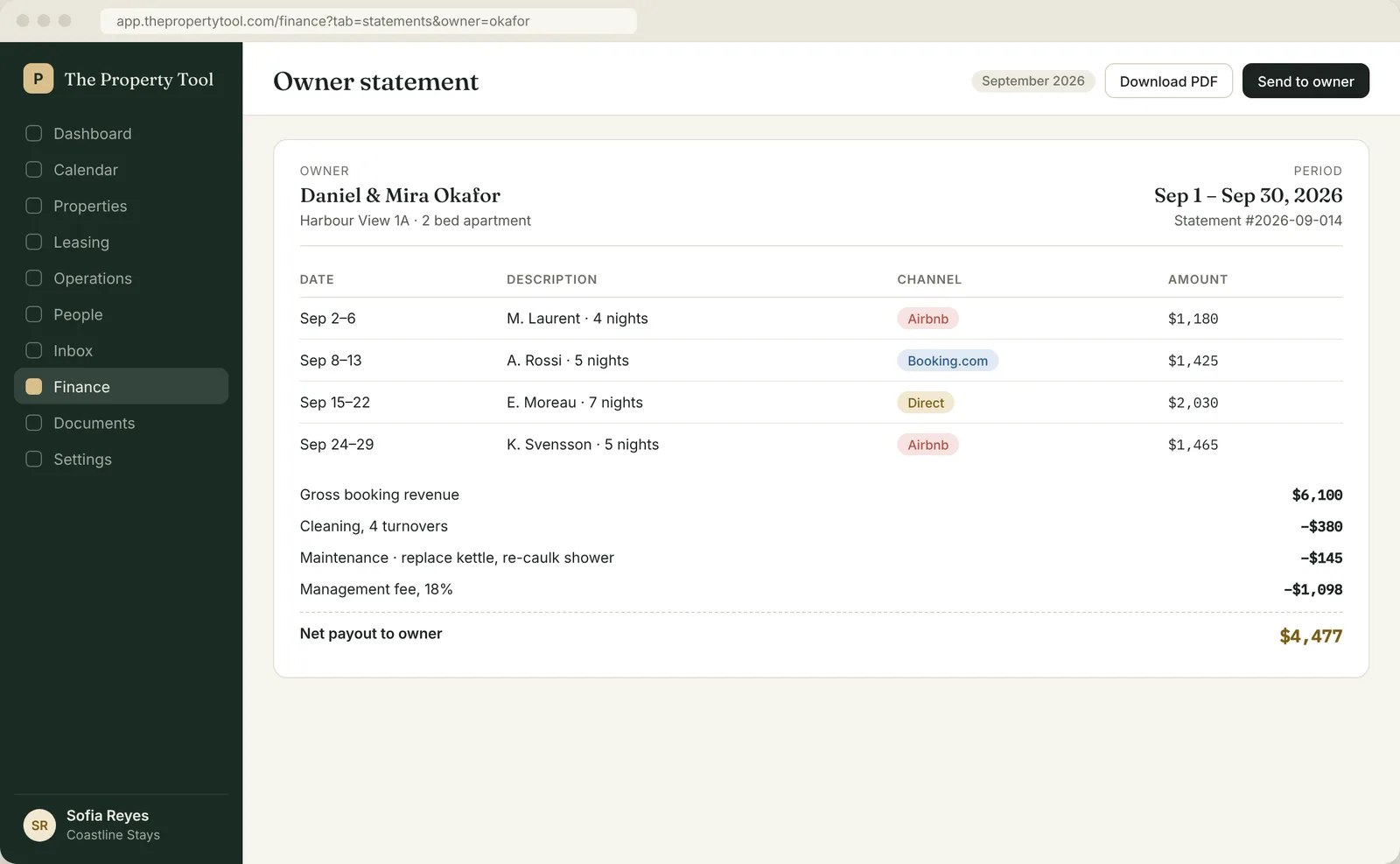
Here the working surface is the calendar, a task list that fills from checkouts and maintenance requests, and a people view for tenants and owners. Statements and reports come from those records instead of from a designed report.
The trade-off is stated plainly in the table above: if a workflow needs a custom field and a custom report, expect to adapt to what exists rather than to build it.
What you would give up
Large managers lean on Rent Manager because it can model almost anything, and because partners and consultants exist who know it well. You would lose the report designer, the extended customisation and, if you manage commercial property, the specialised workflows built for it.
If your team includes someone who enjoys administering the system and your requirements are specific, the depth is worth keeping.
Switching without a long project
The practical way to test fit is to take one representative property, with its tenant, its charges and a few months of ledger, and run it end to end. If statements and rent roll come out correctly, scale up; if you find yourself wishing for a field that does not exist, you have learnt that cheaply.
Pricing is by unit with every module included, so there is no module list to negotiate and no extra charge for the owner portal or e-signatures.
A quick way to decide
List the customisations you actually rely on today: the fields, the reports, the workflow rules. Be strict and keep only those somebody used last month. If the list is short, most of the platform’s depth is unused and a simpler system will feel like relief. If it is long and each item matters to how you bill or report, the depth is doing real work and you should plan around keeping it.
When The Property Tool is the better fit
If you want a system you can learn in a day, that already handles owner statements, bookings and tenants without a configuration project, The Property Tool is the lighter choice.
When Rent Manager is the better fit
If your portfolio is large or unusual, you manage commercial or association property, and you have someone to configure custom fields, workflows and reports, Rent Manager is worth evaluating directly.
Other Rent Manager alternatives
- BuildiumBest for: large residential portfolios with complex lease and trust accounting, plus associations
- AppFolioBest for: several hundred residential units run by a team with a dedicated finance function
- TurboTenantBest for: individual landlords with one or two units who want free listing, screening and rent collection
- DoorLoopBest for: all-in-one long-term residential or commercial leasing with deep accounting
- Rentec DirectBest for: long-term residential leasing with trust accounting and tenant screening built in
- Yardi BreezeBest for: audited property accounting with a path into the wider yardi ecosystem
- RentvineBest for: established residential management companies moving off an older platform
- PropertywareBest for: large single-family rental portfolios that want a deeply configurable platform
- AvailBest for: diy us landlords filling long-term vacancies with free listing, transunion screening and rent collection
- RentRediBest for: hands-on landlords who want a tenant app and a flat annual bill that does not rise with unit count
- InnagoBest for: independent us landlords who want a full landlord os at $0, funded by tenant payment and screening fees
- HemlaneBest for: owners who want software plus optional repair coordination or a done-for-you management assistant
- BaselaneBest for: investors who want property-level bank accounts, bookkeeping and rent collection more than a pm system
- TenantCloudBest for: self-managing landlords who want listings, screening and rent collection in a tiered plan
- Landlord StudioBest for: diy landlords who want receipt capture and tax-ready reports above everything else
- StessaBest for: investors who want income, expense and return tracking from linked bank accounts
- Zillow Rental ManagerBest for: landlords who mainly need to advertise vacancies, take applications and screen at no subscription cost
- EntrataBest for: operators of larger apartment communities with leasing staff and enterprise reporting needs
- CINC SystemsBest for: management companies that run many community associations and rely on violation and board workflows
Common questions
Can I create custom fields and reports?
Not in the way a report designer allows. There are standard reports and exports; anything beyond that is done in a spreadsheet from the export.
Does it support commercial properties?
The product is built for residential, short-term and association management. If commercial leasing is central to your business, check carefully before moving.
How long does a migration take?
For a small portfolio, an afternoon for the first property and a few days for the rest. Large, heavily customised accounts take longer and are better moved in stages.
Is there an onboarding fee?
There is no charge for setup or for migrating, and the trial runs fourteen days without asking for a card.
See it running on your portfolio.
Create an account and add your first property — no setup calls required.
Create your accountRelated pages
Colorado landlord-tenant laws: what changed and what to know
Colorado tightened its security deposit cap and rewrote its notice periods by length of tenancy. Here is what currently applies, including the newest changes.
Landlord-Tenant LawCalifornia rent increase laws: notice periods, the cap, and how to serve a valid notice
A California rent increase notice needs more than the new number — it needs a specific set of details and the right notice period, or it is not valid. Here is exactly what applies.
Lease AgreementPet addendum: what to include and why it protects both sides
A pet addendum is what turns "tenants have a dog" into an enforceable, documented lease term — covering fees, breed and weight rules, and what happens if the pet changes. Here is what to include.