An iGMS alternative when statements and owners matter as much as the calendar
iGMS is a short-term rental platform known for a multi-calendar, automated guest messaging and coordination of cleaners. If your week is increasingly about reporting to owners, here is how The Property Tool compares.
How they compare
iGMS earned its place with the practical problems of a host-manager: one calendar for every listing, messages that send themselves at the right time, and cleaners told when to turn a property over. Those are the hours you gain back first. The comparison changes when the property belongs to someone else and the month ends with a statement to write.
| Area | The Property Tool | iGMS |
|---|---|---|
| Strongest at | Turning stays into owner statements, tasks and a lease ledger in one account | Multi-calendar, scheduled messaging and cleaner coordination |
| Guest messaging | Unified inbox threaded by property and stay | Automation and templates are a core strength |
| Cleaning and turnovers | Tasks raised from checkouts with checklists | Cleaner scheduling and notifications from the calendar |
| Owner reporting | Fee rules, splits, statements and an owner portal | Secondary to the host workflow |
| Long-term tenants | Leases, rent charges and a tenant portal included | Built for short stays |
| Pricing shape | A base covering five units, then a price per unit | Plans scaled to the number of listings |
Where hosts and managers diverge
A host answers to guests. A manager answers to guests and to owners. The first is a communications problem and a tool that automates messages solves most of it. The second adds a financial problem: what each property earned, what it cost and what is owed back.
If you are somewhere in between, the useful test is what you do on the first of the month. If it is writing statements by hand, the gap is on the owner side, not in the calendar.
What the owner layer replaces
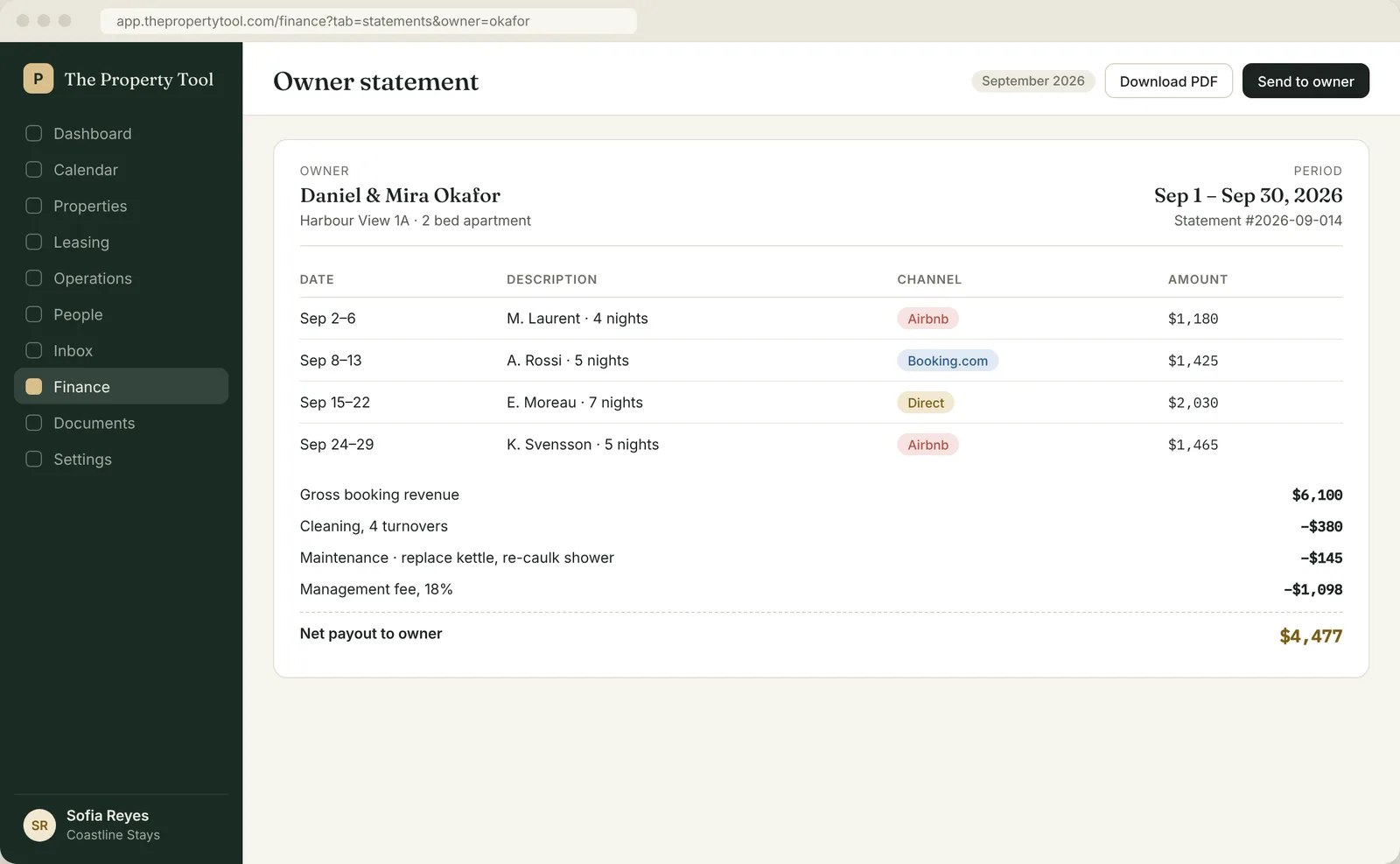
In The Property Tool each stay posts to its property, the fee follows a rule you set once, and the owner statement is simply those records for the period. Properties with two owners divide through owner splits, and each owner can read their own figures in the owner portal.
That is what usually disappears after a move: the spreadsheet that sat beside the calendar and was reconciled against bookings every month.
What you would give up
Messaging automation is iGMS’s home ground, and the rules for timing, languages and conditional templates are deeper there. Here the inbox is unified and threaded, with automations for tasks, but it is not a messaging rules engine.
If hundreds of guest messages a week are your largest cost, weigh that before moving, and consider whether you need both a messaging tool and a management system.
Moving the calendar safely
Move one listing first. Connect its channels, create a test booking and confirm that the dates close on every other channel before you touch the rest. Leave the old calendar in charge of each listing until the new one proves itself.
Export open reservations so future stays and payment status carry across, and note which messages were scheduled so guests with upcoming arrivals do not receive two sets or none. Channel sync is calendar based, so rates stay managed where you manage them today.
A fair way to compare
Count the hours of the last month by activity: messaging, scheduling cleans, bookkeeping and owner reporting. The tool that removes the largest block is the one worth paying for. If messaging dominates, a messaging tool is the better purchase. If bookkeeping and reporting dominate, you need the system that produces them from the stays.
When The Property Tool is the better fit
If owners, fee splits and monthly statements are the heaviest part of your week, or you mix short stays with long-term tenants, The Property Tool produces them from the same records as your calendar.
When iGMS is the better fit
If you manage your own listings, want guest messaging to run itself and need cleaners coordinated from a multi-calendar, iGMS is worth evaluating directly.
Other iGMS alternatives
- GuestyBest for: large listing volumes distributed across many booking channels
- HostawayBest for: distribution breadth and a large integration marketplace
- HostfullyBest for: guest-facing polish: digital guidebooks, upsells and a refined booking experience
- OwnerRezBest for: hosts who want granular control over channel rules and custom workflows
- LodgifyBest for: hosts managing their own listings who want a branded direct-booking website
- HospitableBest for: ai-assisted guest messaging and automation across a growing set of listings
- SmoobuBest for: hosts and small managers who want a simple calendar, channel sync and a direct-booking page
- UplistingBest for: small and mid-sized short-term portfolios that want direct channel connections
- Beds24Best for: operators who want api channel connections and highly configurable rules
- StreamlineBest for: larger vacation rental management companies that want deep owner accounting and housekeeping modules
- TokeetBest for: hosts and small managers who want a flexible channel manager that connects to other tools
- Rentals UnitedBest for: managers who need broad channel distribution with rates and content pushed to many platforms
Common questions
Can The Property Tool schedule guest messages?
Check-in details and reminders can be sent from the unified inbox, but it is not a conditional-rules messaging engine like the one iGMS is known for.
Does it coordinate cleaners?
Yes. Cleaning scheduling raises a task from each checkout with a checklist and deadline.
Can I keep iGMS for messaging and add this for owners?
Some managers do. Keep one authoritative calendar and make sure the two systems do not both write to it.
Is there a trial?
Yes, 14 days without a card, enough to run one property through a full month-end.
See it running on your portfolio.
Create an account and add your first property — no setup calls required.
Create your accountRelated pages
Data export
Your bookings, expenses, and statements, out in a format your accountant or another tool can actually use — never locked in a system you cannot get data back out of.
GrowthCo-hosting fee structures: what to charge and how to track it
Co-hosting fees range from 10% to 25% of revenue depending on what is included. Here is how the common structures work, and why the tracking matters as much as the number.
Tenant OperationsLease renewal reminders: building a system so nothing lapses
A lease that expires without anyone noticing turns into a month-to-month tenancy by default in most states — not a decision, an accident. Here is how to build a renewal process that catches it early.