A Stessa alternative when tracking returns becomes running properties
Stessa is a popular tool for rental investors who want income, expenses and performance tracked across a portfolio, with banking and reporting alongside. If you now run day-to-day operations as well, here is how The Property Tool compares.
How they compare
Stessa answers an investor’s question well: what is this portfolio earning, and how is each property performing against what I paid? That is a view from above the operations. The comparison shifts when you also hold the keys, answer the tenants and report to co-owners, because the work is then in the details of each month, not the overall return.
| Area | The Property Tool | Stessa |
|---|---|---|
| Viewpoint | The operator: calendar, tenants, tasks and statements | The investor: income, expenses, returns and valuation |
| Bookkeeping | Income and costs posted from stays, leases and tasks | Automatic categorisation from linked bank accounts |
| Tenants and leases | Lease records, e-signatures, rent collection and portal | Rent collection and basic tenant tools |
| Short-term rentals | Booking calendar, channel sync and turnovers | Not designed for nightly stays |
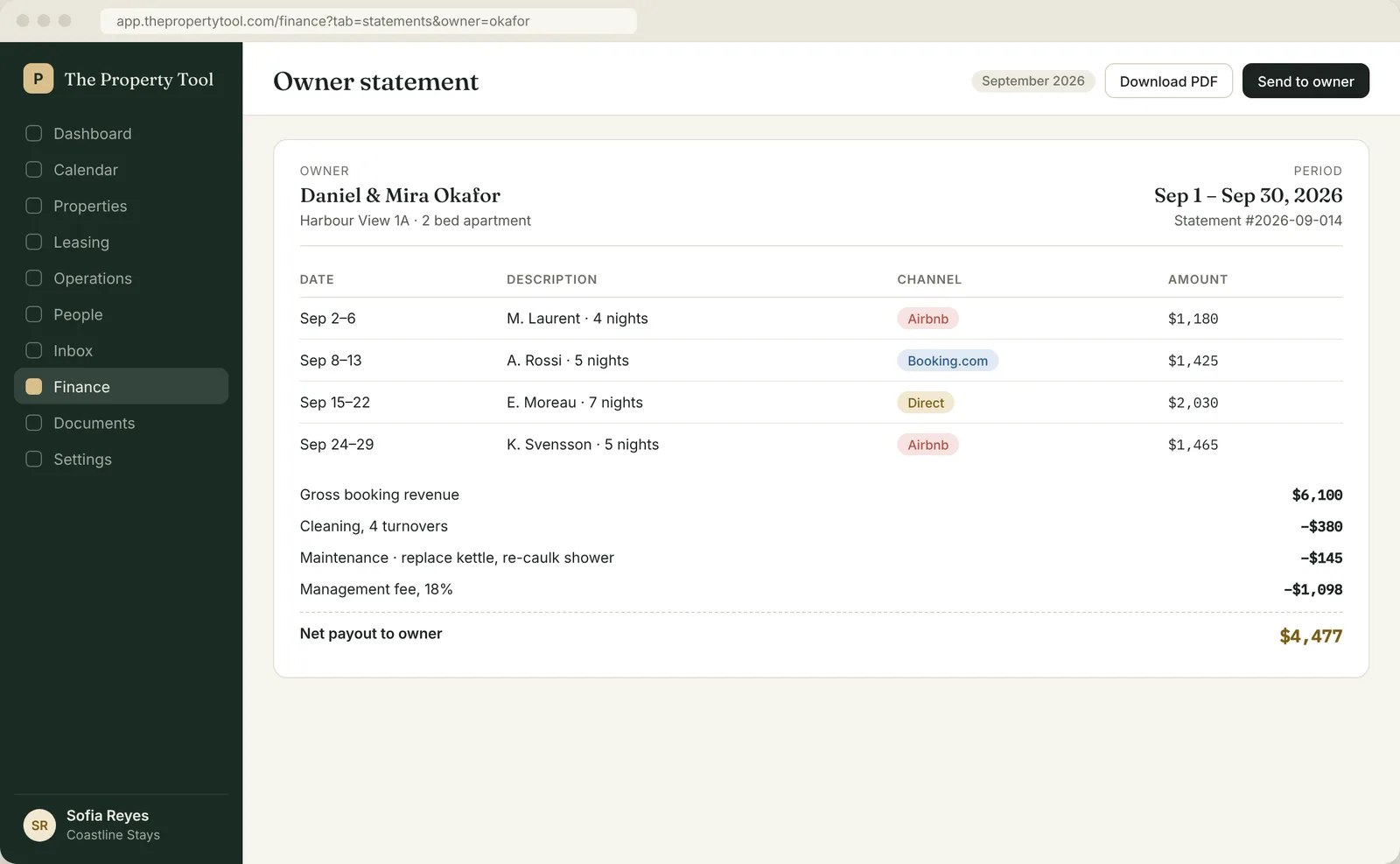
| Owner reporting | Statements, fee rules and splits for co-owners | Reports for the investor who owns the property |
| Pricing shape | A base plus a price per unit, every module included | A free core product with paid tiers for more |
Investor view or operator view
An investor wants to know whether a property is a good use of money. An operator wants to know whether next week is covered: who is arriving, who is cleaning, which repair is open and whether the rent came in. Both need the numbers, but they begin from different places.
If you are asking the first question, an investor tool is the right size. If you spend your week on the second, the numbers should come out of the operation instead of being layered over it.
Bank-feed bookkeeping versus operational records
Categorising bank transactions produces tidy books after the fact. Posting income from a booking or a lease charge, and costs from a closed task, produces the same books as a side effect of the work, with property and owner attached from the start.
The reports here are built from those records, and exports give your accountant the figures per property. For tax, keep an accounting tool if your accountant prefers one.
What you would give up
Investor tools do well at portfolio-level views, valuation tracking and linked bank accounts, which this product does not attempt. If you have no operational burden, because a manager runs everything, you may prefer a tool that simply shows you the result.
This is a system for the person doing the work, and it will feel heavy if your main need is a dashboard.
Moving across
Export the transactions per property and decide the cut-off date, ideally the start of a tax year. Bring in properties, units and current leases, then open balances. Run one month in parallel and compare property totals before closing the old account.
For a mixed investor-operator portfolio the investor use case shows how the pieces fit.
Keeping both
Plenty of people use an investor dashboard for the big picture and an operations system for the details. If you do, treat one as the source of truth for each number. The usual failure is two sets of totals that differ by a few hundred dollars and nobody knows which is right.
When The Property Tool is the better fit
If you run tenants, bookings and repairs as well as owning, or you report to co-owners, The Property Tool keeps the operation and the numbers in one place.
When Stessa is the better fit
If you are an investor who wants portfolio-level income, expense and return tracking from linked bank accounts, with little day-to-day management, Stessa is worth evaluating directly.
Other Stessa alternatives
- BuildiumBest for: large residential portfolios with complex lease and trust accounting, plus associations
- AppFolioBest for: several hundred residential units run by a team with a dedicated finance function
- TurboTenantBest for: individual landlords with one or two units who want free listing, screening and rent collection
- DoorLoopBest for: all-in-one long-term residential or commercial leasing with deep accounting
- Rentec DirectBest for: long-term residential leasing with trust accounting and tenant screening built in
- Yardi BreezeBest for: audited property accounting with a path into the wider yardi ecosystem
- RentvineBest for: established residential management companies moving off an older platform
- PropertywareBest for: large single-family rental portfolios that want a deeply configurable platform
- AvailBest for: diy us landlords filling long-term vacancies with free listing, transunion screening and rent collection
- RentRediBest for: hands-on landlords who want a tenant app and a flat annual bill that does not rise with unit count
- InnagoBest for: independent us landlords who want a full landlord os at $0, funded by tenant payment and screening fees
- HemlaneBest for: owners who want software plus optional repair coordination or a done-for-you management assistant
- BaselaneBest for: investors who want property-level bank accounts, bookkeeping and rent collection more than a pm system
- TenantCloudBest for: self-managing landlords who want listings, screening and rent collection in a tiered plan
- Landlord StudioBest for: diy landlords who want receipt capture and tax-ready reports above everything else
- Rent ManagerBest for: large or unusual portfolios, including commercial, that need deep customisation
- Zillow Rental ManagerBest for: landlords who mainly need to advertise vacancies, take applications and screen at no subscription cost
- EntrataBest for: operators of larger apartment communities with leasing staff and enterprise reporting needs
- CINC SystemsBest for: management companies that run many community associations and rely on violation and board workflows
Common questions
Does it track property value and returns?
It reports income, costs and margin per property. It does not track valuations. The ROI calculator and cap rate calculator help with investment maths.
Can it connect to my bank?
Transactions can be imported from your bank, but the model is operational records first, not bank-feed categorisation.
Is it suitable if I own only two properties?
It works at that size, since pricing follows the number of units. If you do not manage anything day to day, a lighter investor tool may be enough.
Do I get Schedule E reports?
Exports give your accountant income and expenses by property. See the rental income and expense spreadsheet for the categories.
See it running on your portfolio.
Create an account and add your first property — no setup calls required.
Create your accountRelated pages
Security deposit management: what landlords get wrong
Deposit disputes are one of the most common sources of landlord-tenant conflict, and most of them come down to documentation, not the amount withheld. Here is how to manage deposits so they hold up.
Tenant OperationsTenant screening: what checks actually predict a good tenant
Credit scores get the most attention, but they are not the strongest signal available. Here is what a tenant screening process should actually weigh, and why.
Buying GuideSelf-managing vs. hiring a property manager: doing the math
The 8-12% management fee looks like the whole cost of hiring help until you price out what your own time is actually worth. Here is how to run the real comparison.