A pool is many owners and one business
In a rental pool, owners of units in a resort or condo-hotel put their units into one rental program. Guests book the building, not a particular owner, and revenue goes into the pool before it is shared out. The operator has to run it as one business, with one calendar, one set of rates and one set of costs, while accounting to dozens of owners who each own one unit.
The split has to be a rule
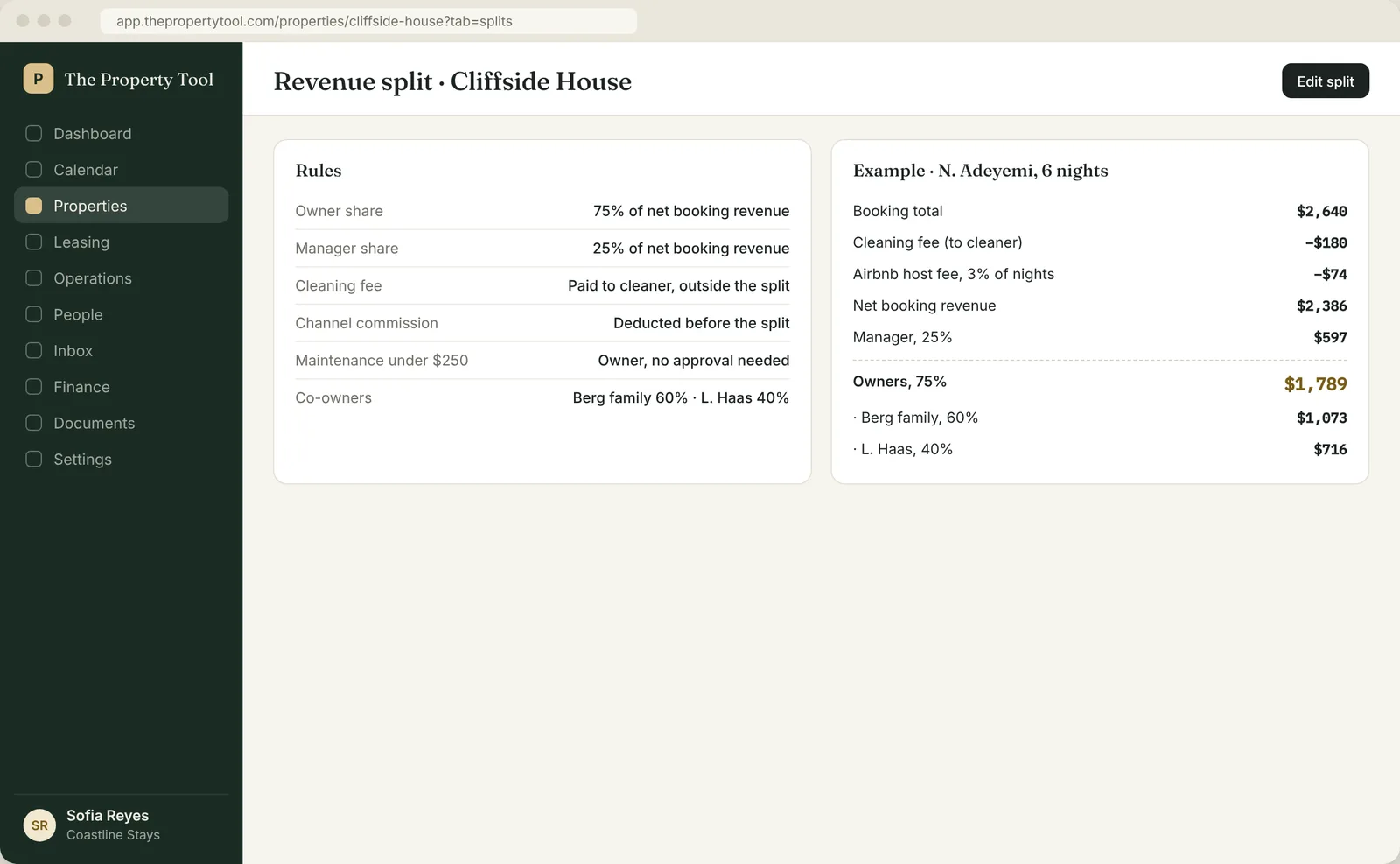
Pool agreements divide net revenue by participation points, by the nights each unit was rented, or by a mix of both, after the operator’s fee and shared pool expenses. The Property Tool applies that rule to every unit in every period, so an owner can follow their distribution from the pool totals to their own line without a spreadsheet maintained by one person in the back office.
Owners can see it for themselves
Pool owners ask the same questions as any other owner, and a few more: how the pool did, what came out of it before the split, and why their unit’s share is what it is. Each owner gets a portal with the pool totals, the fee, the expenses and their own share, built from the same ledger the operator closes the period with.
Points, nights or both
A pure points pool shares risk evenly: each unit earns according to its points, whichever units guests actually stayed in. It suits buildings where the front desk assigns rooms. A nights pool pays each unit for the nights it was rented, which rewards the best units and suits buildings where guests book a specific unit. Hybrids split part of the net by points and the rest by nights.
Whatever the agreement says, the arithmetic is the same each period: gross revenue, minus the operator’s fee, minus pool expenses, then the split. The free rental pool distribution calculator works it through on your own numbers, and rental pool management fees explained covers how operators charge.
Owner stays and withdrawn units
Owners use their own units, and the pool agreement says how that is treated: often owner nights are excluded from the nights count, sometimes they carry a cleaning fee, and a unit withdrawn for a season may lose its points for that period. On the booking calendar an owner stay is a block like any other, so it is visible to the reservations team and counted correctly in the split.
Pool expenses and unit expenses
Some costs belong to the pool, such as front desk, marketing, booking commissions and linen. Others belong to one unit, such as a broken air conditioner or a new sofa, and are charged to that owner alone after the split. Keeping the two apart is what makes a pool statement credible: maintenance charges unit repairs to the right owner, and owner statements show both layers.
Distribution, fees and the statement
At the end of each period the operator closes the pool, applies the fee and expenses, splits the net and pays each owner. The statement each owner receives should show the pool’s gross revenue and occupancy, the fee and expenses, how their share was calculated, the unit expenses charged to them and the payout. Because it comes from the same ledger as the reservations, the statement and the bank transfer always agree.
Rules that differ by market
Rental pools are common in Florida, Hawaii, the Caribbean and Mexico, and in ski and beach resorts in Europe, and each market has its own rules on licensing, tourist tax and how a pool may be sold to buyers. In the United States, a unit sold together with a mandatory rental pool can be treated as a security, which is one reason many condo-hotels run voluntary rental programs instead. Take local advice before you change a program’s terms.
Pools alongside other properties
Many resort operators also manage stand-alone vacation homes and long-term rentals. They sit in the same account as the pool, so a manager does not need a second system for the villas next to the hotel; see vacation rental property management software and the pricing page.
Common questions
What is a rental pool?
An arrangement in which owners of units in a resort or condo-hotel put their units into one rental program, and the net revenue is shared between them under a pool agreement.
How is rental pool revenue split?
After the operator’s fee and pool expenses, by each unit’s participation points, by the nights each unit was rented, or by a mix of both, as the agreement sets out.
Can owners stay in their own units?
Usually yes, under the agreement’s rules. Owner stays are blocked on the calendar and treated as the agreement says, for example excluded from the nights count.
Can each owner see how their distribution was calculated?
Yes. Each owner’s portal shows the pool totals, the fee and expenses, their share and any expenses charged to their unit.
Does it handle units outside the pool?
Yes. Stand-alone vacation homes and long-term rentals sit in the same account.